
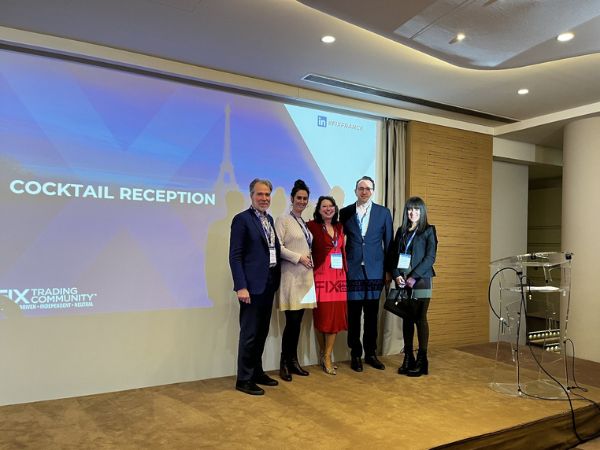
Agents entering workflows, retail AI execution emerging, institutions building agent platforms, and regulators tightening controls – with Eric Helene of AXA IM, Charles LeHalle and Hanane Dupouy and Iris Lucas of the AMF
AI in trading may not be new, but its scope is rapidly expanding as agentic systems move from experimentation into real workflows. Trading desks have long used data-driven automation – from portfolio engines to execution algos – but modern AI, especially LLMs and agents, is now bringing a step change in speed, scale and flexibility. This week’s discussions in Paris offered a clear view of how institutional desks are adopting these tools, how regulators are responding, and how broader industry developments – from new AI agents to new standards such as TeaRAG – are shaping the next phase of AI-enabled markets. Here’s what we learnt this week on AI in Trading.
1. Back to the Future at FIX France
Two years after the first FIX panel on AI in Trading (https://bit.ly/47Yjbnd), this week’s session showed just how far the industry has moved on. Deterministic, rules-driven automation is now being augmented by agentic systems able to process unstructured data, extract sentiment and compress decision cycles. While the core goals of execution – liquidity capture, cost control, and avoiding adverse selection – remain the same, increasing market fragmentation is beginning to make AI indispensable for maintaining execution quality.
Yet fully autonomous AI is still risky: outputs remain unpredictable, forcing desks to build evaluation frameworks to score model behaviour and reduce hallucination risk. Firms are adopting multi-agent setups, restricting outputs to structured formats like JSON, and keeping final decisions deterministic.
At a market-structure level, the benefits of AI come with new risks – faster spread of misinformation, new avenues for manipulation and growing dependence on big tech providers. Regulators are responding by increasing their own use of AI for surveillance, while firms debate build-versus-buy strategies and even the push for open-source OMS/EMS standards. The panel’s message was clear: preparing for AI-enabled execution requires investment in technology, high-quality data and skilled people. As Charles-Albert LeHalle (https://www.linkedin.com/in/lehalle/)reminded the audience, understanding where markets are heading also means revisiting where microstructure began. The suggestion being to read Albert Kyle’s 1985 paper “Continuous Auctions and Insider Trading” (https://people.duke.edu/~qc2/BA532/1985%20EMA%20Kyle.pdf), still the foundation for understanding how AI, agents and execution systems shape price formation.
2. From TOON to TeaRAG
Following last week’s discussion of TOON, this week introduced TeaRAG – another attempt to make agentic AI cheaper, faster and more reliable (https://arxiv.org/abs/2511.05385). TeaRAG focuses on building AI agents on top of verified knowledge graphs rather than raw documents, checking every new fact against related data to ensure accuracy. A two-step verification pipeline scores source reliability, checks consistency and stores information with confidence levels. It also reduces token use by compressing what agents retrieve and how they reason, reportedly cutting token costs by around 60% while improving accuracy.
TOON tackles a different layer of the problem by replacing JSON with a more compact format, reducing token overhead for structured data. TeaRAG reduces tokens in retrieval and reasoning; TOON reduces tokens in data formatting. Together, they support the development of fast, reliable enterprise-grade agentic systems..
3. AI-Powered Brokerage Moves into Direct Execution
At the Paris panel, participants raised growing concerns about how retail investors are navigating AI-generated financial guidance – concerns that will likely increase following Public.com’s launch of its AI-powered brokerage interface (https://www.instagram.com/publicapp/reel/DRKbvzkEc1c/). The platform now lets users speak to their laptop to build investable indexes and, beginning next year, will introduce an AI-driven wealth manager. AI is no longer confined to research, education, or advisory layers but is moving directly into retail execution, where decisions translate immediately into market flow.
What this means for trading; Such tools could democratize portfolio construction, yet they also heighten risks around over-reliance on opaque models, suitability, and the speed at which inexperienced users can take complex positions.
4. Institutional Shift Toward AI-Native Trading Infrastructure
Institutions are also laying the groundwork for markets dominated by autonomous trading agents. Waton Financial’s partnership with Panda AI to launch a Global Competition for AI Agents in Securities Trading – starting in Greater China with plans for global expansion – is one of the first major efforts to build an institutional-grade platform for agent-based strategies. The initiative aims to attract top AI trading teams, accelerate innovation, and position Waton as core infrastructure for machine-driven market participation. Read more here – https://www.nasdaq.com/press-release/waton-financial-limited-partners-panda-ai-launch-global-ai-trading-agent-competition
What This Means for Trading: for desks, this signals a future where agent-versus-agent interactions influence liquidity, price formation, and volatility. Running autonomous agents in live markets introduces challenges far beyond simulation, including model drift, latency management, market-impact risk, and the opacity of non-deterministic strategies. Regulatory scrutiny is likely to increase as agent activity scales. If successful, competitive edge may shift from single-model performance to the coordination and governance of multiple interacting agents, requiring new approaches to execution quality, monitoring, and risk oversight.
5. MAS Proposes Formal AI Risk-Management Rules
The Monetary Authority of Singapore has released a new consultation paper that moves AI oversight from broad principles toward a formal, operational control framework for financial institutions (https://www.mas.gov.sg/-/media/mas-media-library/publications/consultations/bd/2025/final_consultation_paper_on_guidelines_on_ai_risk_management_forrelease.pdf?utm_source=chatgpt.com). MAS emphasises that AI risk becomes material when systems are embedded into core business or operational functions, requiring firms to manage AI across its full lifecycle – not just as a model-governance issue, but as part of end-to-end workflow, infrastructure, and organisational processes.
The timing aligns with broader industry concerns about operational resilience and dependency on large cloud and infrastructure providers, highlighted in recent discussions following high-profile outages and ongoing debate about the systemic role of hyperscale platforms. MAS’s approach reflects a wider regulatory shift: AI risk cannot be separated from the technical environments it runs on or the operational processes it influences.
Thank you for reading. As always, I’d love to hear your thoughts – what you agree with, where you disagree and what you’d like to see more of next time.
Best wishes,
Rebecca