
From Agentic Systems to Infrastructure Risk and Regulatory Pushback
Apologies, this week’s newsletter is officially something FROM the weekend rather than for – working on a deadline. However …
AI’s influence on global market structure increasingly shaping trading workflows, infrastructure resilience, governance expectations, and even geopolitical strategy. A consistent theme is emerging: AI – and its agents – are scaling faster than the frameworks being designed to minimise risks. From the rise of autonomous agents to fragilities in core market infrastructure, and from chip-supply geopolitics to Europe’s shifting regulatory stance, the financial system is being pushed into a new era where innovation, risk, and oversight collide. The developments below illustrate how rapidly the centre of gravity is moving – and how unprepared many parts of the ecosystem remain. But this week is mainly all about the Agents, – Agentic and Autonomous so I will start with a current definition given the ferocity of the debate currently:
– Agentic Workflows refer to systems that can take actions such as calling tools, writing files, running code, or interacting with external services but within human-defined scopes, prompts, and guardrails. An agentic model executes multi-step tasks, reasons about what to do next, and orchestrates tools, but it still operates within a bounded workflow initiated and supervised (directly or indirectly) by a user or developer; versus
– Autonomous AI Agent (with limited human intervention) by contrast, implies a system that can set its own goals or continue acting without ongoing human oversight, deciding when to act, what tasks to pursue, or when to stop. Autonomy requires persistent agency plus self-direction, long-term memory, and unsupervised judgment about objectives – capabilities that are far less common and raise higher safety, governance, and reliability issues. Please feel free to share your views on this as it is still being hotly debated!
1. FMLS – Last week Paris, this Week London – still discussing AI’s role in the future of markets
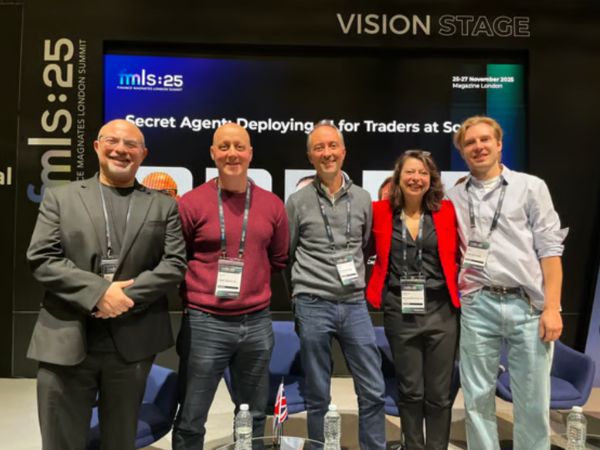
At this year’s Finance Magnates London Summit (Nov 25–27, 2025), following similar conversations in Paris the week before, discussions remained firmly on AI’s evolving role in the future of financial markets. In a panel moderated by @TipRanks’ Global Head of Enterprise Solutions, @JoeCraven “Secret Agent: Deploying AI for Traders at Scale” – @DavidDyke (CMC Markets), @GuyHopkins (FairXchange), and @IharMarozau (Capital.com) and I discussed examples of the real-world impact of AI in trading. The view was it has become such a major focus not because the underlying technology is new – ML algos, RL and neural networks – but the surge of interest in GenAI and confusion about what “AI” really now means. The industry is exploring how to apply these tools meaningfully, especially in managing overwhelming data volumes, improving decision support, and creating more personalised, flexible systems. Yet use of AI also exposes long-standing issues such as poor data quality, fragmented infrastructure, and the difficulty of integrating new tools into regulated workflows. Significant challenges remain around governance, compliance, explainability, and human overreliance on AI outputs, raising the question of whether AI is sometimes a “solution in search of a problem.” Ultimately, making AI effective requires not just technology but cultural change: cleaner data, clearer distinctions between types of AI, strong oversight, and ensuring humans remain accountable for critical decisions – particularly as we move to greater use of AI in agentic workflows.
2. Everything Agentic this Week
These views were backed up by more developments in agentic AI, highlighted by Franklin Templeton’s new partnership with Wand AI to deploy autonomous agents that accelerate research, streamline operations, and support alpha generation (https://investors.franklinresources.com/news-center/press-releases/press-release-details/2025/Franklin-Templeton-and-Wand-AI-Forge-Multi-Year-Strategic-Partnership-to-Advance-Agentic-AI-in-Asset-Management/default.aspx). The move gives an example of how the asset management industry rapidly shifting from small AI pilots to enterprise-scale agentic systems under strict governance and compliance. This reflects a wider push to boost productivity and handle complex analysis while identifying where AI truly delivers ROI without sacrificing oversight.
Reinforcing this momentum, the World Economic Forum released a paper outlining a blueprint for moving from experimentation to deployment, warning that with 82% of executives planning to adopt agents within one to three years, the gap between fast adoption and mature governance is widening, creating risks in autonomy, safety, system integration, and trust; the report details the technical foundations of agents, a functional classification system based on autonomy and context, and a progressive governance framework linking safeguards directly to task scope. Read more here – https://www.weforum.org/publications/ai-agents-in-action-foundations-for-evaluation-and-governance/
In parallel, Anthropic’s launch of Claude Opus 4.5 signalled a broader industry pivot from text outputs to fully agentic capabilities – demonstrated by more than 30% of enterprise usage now involving tool calls, file writing, and external system operations – while also strengthening Anthropic’s lead in coding by outperforming all human candidates on its toughest engineering test and topping SWE-bench Verified. Read more here – https://www.anthropic.com/news/claude-opus-4-5
3. Along with Agents – More on MAS
A new paper highlighted by https://www.linkedin.com/in/ingason/, introduces LatentMAS – a multi-agent framework in which LLM agents collaborate entirely in latent space, eliminating the need for NLP message exchange and significantly reducing MAS operating costs. Instead of producing text, each agent emits latent thoughts (its internal hidden states). These high-dimensional representations are far more expressive than tokens, and agents can even share their full KV-cache – effectively their working memory – allowing lossless transfer of internal reasoning between agents. The paper cites LatentMAS demonstrating notable efficiency and performance gains:
· 4× faster inference
· 70–84% fewer tokens
· Up to 14.6% higher accuracy across math, science, coding, and commonsense tasks
But the paper’s comment section raises a critical issue for regulated environments such as trading – if agent-to-agent interaction occurs fully in latent space, you lose natural-language traces that currently underpin auditability, supervision, explainability, safety reviews, and post-trade analysis. As AI agents move closer to production in trading – the lack of human-readable logs poses a material governance risk. Read more here – https://arxiv.org/abs/2511.20639
4. Geopolitics & CME Group
AI’s broader future is increasingly shaped by export controls, chip supply constraints, national AI-industrial strategies, and divergent cross-border regulation. These factors now heavily influence who leads in AI and where development can occur (see: https://cybernews.com/ai-news/chinas-tech-giants-ai-development-overseas-secure-nvidia-chips)
Recent events also illustrate the market impact when critical infrastructure fails. A major cooling breakdown at CME Group’s primary data centre in Aurora, Illinois which sent temperatures above 120°F and caused a 10-hour outage that froze trading in some futures contracts late on Thanksgiving. The chiller-plant failure underscored the growing fragility of digital market infrastructure at a time when AI-driven demand is already straining data-centre capacity. Although the disruption was minimised due to it occurring on a market holiday, it has raised serious concerns about resilience, redundancy, and CME’s heavy dependence on its Aurora hub. When CME halted, the market went opaque. Algos were left in a “zombie state”, unable to determine whether orders had been filled, resting, or rejected at the point of failure – a scenario reminiscent of late-1990s Nokia trading outages. The episode highlights a persistent structural risk: firms relying on a single-exchange feed for position-keeping effectively lose their risk controls when that feed goes dark. One to watch to see how market participants – and regulators respond. Read more here – https://www.wsj.com/finance/cme-options-futures-trading-halted-amid-data-center-issue-16e96ed1
5. Continuing Tensions between innovation and regulation in Europe:
The European Commission is facing accusations of a “massive rollback” of EU digital protections after proposing to delay key obligations of the AI Act and water down GDPR, making it easier for tech firms to use personal data for AI training without explicit consent while reducing “cookie banner fatigue” through fewer tracking prompts. The plan—part of a broader “digital omnibus” effort to streamline the GDPR, AI Act, ePrivacy Directive and Data Act—would give developers of high-risk AI systems (e.g., models used in surgery or exam scoring) up to 18 extra months to comply. The shift follows political pressure after Mario Draghi warned that Europe is falling behind the US and China in innovation, and amid calls from the Trump administration to soften EU digital rules. Economy Commissioner Valdis Dombrovskis argues the changes could save €5bn in administrative costs by 2029, aligning with the EU’s wider deregulatory push across environmental, supply-chain and agricultural rules. Civil society groups such as EDRi warn the reforms amount to a dismantling of core rights, enabling “unchecked” use of intimate data and allowing companies to access device-level information without user permission. Industry groups broadly welcome simplification but want the EU to go further, while critics including former Commissioner Thierry Breton caution against unravelling Europe’s digital rulebook under the guise of simplification and note the clear transatlantic pressure driving the rollback. This may accelerate AI adoption across Europe but also raises fresh concerns around privacy, data protection, and oversight – read more here: The Guardian+1
Taken together, these trends signal yet another decisive shift: AI is increasingly moving from experimentation to systemic influence across markets, but the guardrails are still catching up. Agentic systems are becoming operational at scale, yet questions around explainability, accountability, and auditability are intensifying – especially as models begin to act, not just predict. Infrastructure vulnerabilities, whether from data-centre failures or supply-chain choke points, risk amplifying operational shocks just as markets grow more automated and interconnected. Europe’s regulatory recalibration shows how political pressure can reshape the balance between innovation and protection.
As AI becomes further embedded in trading, asset management, and market plumbing, the next phase will depend on building governance, resilience, and transparency robust enough to match the technology’s accelerating capability. The institutions that manage this transition well will shape the future structure and stability of global markets.
Thank you for reading. As always, I’d love to hear your thoughts – what you agree with, where you disagree and what you’d like to see more of next time.
Best wishes,
Rebecca