
AI agents in trading workflows as compute, regulation, and energy start to push back
From Nvidia industrialisation of research and the continued emergence of agentic systems, to diverging regulatory responses and the physical reality of AI implementation and UK councils fighting back – here’s what I learnt this week on AI in Trading:
1. From Blueprint to Production: HRT’s AI Factory
Following last week’s collaboration between NVIDIA, KX and RBC Capital Markets to develop AI blueprints for research and signal generation, this week saw Hudson River Trading (HRT) partner with NVIDIA to build an “AI factory” for next-generation quantitative research. Powered by NVIDIA’s Blackwell architecture and Spectrum-X Ethernet networking, the platform is designed to deliver large-scale, energy-efficient compute directly to researchers covering the full lifecycle – data ingestion, model training, simulation, and deployment – into a unified, high-performance environment, effectively industrialising the research process. Read more here – https://blogs.nvidia.com/blog/gtc-2026-news/?ncid=so-link-375911-vt09&linkId=100000413124830#hudson-river
Why this matters for Trading: this is yet another structural shift toward compute-centric market intelligence. Direct access to scalable, high-throughput infrastructure compresses research cycles, enabling faster model iteration, more complex simulations, and deeper exploration of market behaviour. The competitive edge is increasingly defined not just by models or data, but by the ability to operationalise both at scale – linking connectivity, compute, and workflow orchestration. As more firms adopt similar architectures, differentiation will move toward how efficiently they can translate compute advantage into execution outcomes, raising the bar for connectivity infrastructure, latency management, and model governance across the trading stack.
2. From OpenClaw to NemoClaw
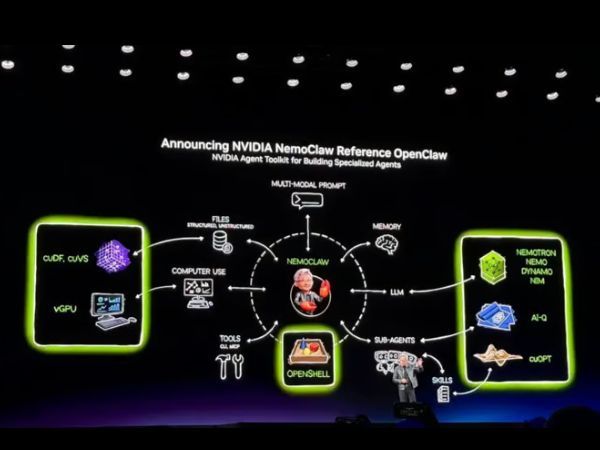
Nvidia used its GTC keynote to signal a rapid shift toward agentic AI, unveiling NemoClaw – its platform that integrates open-source Nemotron models into OpenClaw ecosystem of autonomous “claw” agents. NemoClaw adds optimisation tooling, security guardrails (via OpenShell), and workflow control, positioning Nvidia not just as a chip provider but as a key player in the runtime layer for AI agents. Nvidia also introduced new infrastructure designed specifically to scale the heavy compute demands of agent-based systems. This is a shift from single-model inference to coordinated, multi-agent systems – one example being replicating a trading desk shifting from single-model predictions to coordinated systems of specialised agents across research, execution, and risk operating within structured workflows – read more here https://blogs.nvidia.com/blog/gtc-2026-news
Why this matters for Trading: the real breakthrough is not the agents themselves, but the infrastructure that connects them to real-time market data and live trading environments. As AI becomes embedded directly into execution, competitive advantage will depend on integrating insight without compromising latency, governance, or control. However, as decision-making shifts from instruction to interaction – where do agents analyse, debate, and approve trades collectively – traditional model governance frameworks begin to break down, raising a fundamental question: who is ultimately accountable for the risk?
3. The Quiet Shift: AI Learns How You Work
Structured instruction layers may look insignificant next to AI factories or agents, but they signal a deeper shift: value is moving from models to workflow orchestration. By encoding how tasks are planned, executed, and verified, they allow AI systems to replicate end-to-end processes rather than just generate outputs – read more here https://www.linkedin.com/posts/eordax_ai-claude-activity-7436019436958060544-_daY/ .
Why this matters for Trading; This could be another the missing layer between AI capability and trading performance. Repeatable processes – research pipelines, validation frameworks, execution discipline matter in secondary markets automation. Embedding AI into those processes, with feedback loops, creates compounding advantage. Rather than just deploy models, firms will be able to systematise learning.
4. The Global Regulatory Split
The US AI framework, released Friday, unsurprisingly reinforces a light-touch, innovation-led approach – contrasting sharply with the EU’s structured, risk-based regime under the EU AI Act. The divergence is no longer theoretical; it is now being codified into how firms build and deploy AI systems. Read more here on the US AI framework (its not extensive) – – https://www.whitehouse.gov/wp-content/uploads/2026/03/03.20.26-National-Policy-Framework-for-Artificial-Intelligence-Legislative-Recommendations.pdf?utm_source=thedeepview&utm_medium=newsletter&utm_campaign=u-s-unveils-ai-plan-governance-debate-begins&_bhlid=0dd58297ff14e1f7f861ad1280dcc4ed01326dee
Why this matters for Trading; This creates two different speeds of market evolution. In the US, faster AI deployment will likely accelerate changes in liquidity provision and execution behaviour. In Europe, tighter controls may slow deployment but increase transparency and stability. For global secondary markets, this introduces fragmentation not just in liquidity, but in how that liquidity is generated. Firms will need to operate across both regimes simultaneously optimising for speed in one, versus control in the other.
5. The FCA Reframes AI as Core Infrastructure
The FCA’s latest priorities for 2026 make one thing explicit: AI, data, and technology are no longer innovation topics – they are supervisory ones. Surveillance, model controls, and data integrity are now being treated as fundamental to market trust, alongside traditional concepts like resilience and settlement. Read more here – https://www.fca.org.uk/publication/regulatory-priorities/wholesale-markets-report.pdf
Why this matters for Trading: Similar to what we saw with the MAS Consultation in January, and ESMA’s Supervisory Guidance in February, this is also a shift in accountability. Secondary markets are increasingly shaped by technology decisions – how data is processed, how models behave, how systems interact. Regulators are responding by pulling those decisions into scope. Firms are no longer being assessed as financial institutions using technology, but as tech firms operating in financial markets.
And finally this week – the refusal of a 213MW AI data centre in Edinburgh is the clearest signal yet that AI scale is colliding with real-world constraints. This was not a marginal decision – it was a fully backed project rejected based on energy consumption, planning alignment, and the simple absence of a credible definition of “green.” At scale, proposed data centres in Scotland would require more power than the country’s current peak demand. Read more here – https://www.thenational.scot/news/25944846.edinburgh-council-considers-temporary-ban-ai-data-centres
This is the part of the AI narrative markets have largely ignored: compute is not infinite. For secondary trading, where proximity, latency, and throughput matter, access to power and data centre capacity becomes a competitive variable. Location strategy, where models are trained, where inference runs, how systems connect, starts to matter in a very physical sense.
AI in trading is no longer just about models, or even infrastructure – it is now the end-to-end stack – compute, workflows, regulation, and now energy – where constraints at any layer can define outcomes.
Thanks again for reading – more to follow next week.
As always let me know your feedback/comments
Many thanks
Rebecca